
Do you help your students “Seize the day?”

“Carpe diem… Seize the day.” For the younger readers out there, this was a classic movie, Dead Poet’s Society, 1989. For us older, distinguished veterans, we should remember it well.

31bf5b47a9b5040ddb7cb1ce50037804

There is this one scene that I like where the teacher, Mr. Keating, played by Robin Williams, takes his class out to the commons on the first day of class and has them look at the former students who came before them. While there, Mr. Keating tries to awaken their spirits, per se, into making the most of the time they have. In the clip, these words are spoken by Mr. Keating, “… seize the day boys, make your lives extraordinary.”

Watch the clip here: Carpe diem… Seize the day – Dead Poet’s Society

While watching and listening to the clip, I thought about this… The other day I stopped by the bank on the way home, and the teller asked me how my day at school was. I said, “fine,” and she said, “I don’t know how ya’ll do it.” I figured she was talking about teaching… So I said, “Well, I can either focus on who they are or who they can be.” She just looked at me like I had two heads and changed the subject. I wondered if she wanted to continue the direction of the conversation, but I was not going to speak negatively about education. Sure, we have problems, but so does every other occupation. Anyway…

How does this all tie in? Well, how many times as educators do we “seize the day” to make the lives of our students extraordinary? It’s easy to focus on what walks through the classroom door, but do we ever consider what they can be when they walk out the door? Do we focus so much on the negative aspects of students that we forget that they might not become who they can be without our help? This goes for all aspects of education… Teachers and students, administrators and teachers, School leaders, etc.

While I believe Mr. Keating wanted his students to understand that, ultimately, it is up to the individual to “seize the day.” Knowing or unknowingly, at the same time, he was helping them understand that. That’s where we make the most of who our students can be. Giving them belief, giving them hope for their future, and modeling an example that says, be different for the right reason.

Oh, to help a student to feel extraordinary, to help them “seize the day.” Most might not do that on their own. Let’s help them “seize the day” by us doing the same. Our lives might just feel extraordinary if we do.

Let’s go fight the good fight of leadership. Someone has to…

Go be a great educator and leader today… Our future needs it…

Remember… Think Leadership and Be For Others…

©2023 J Clay Norton

Want more Leadership Thoughts? Follow me on… Twitter @thebookchamber or follow the blog directly.

Guard Your Attention…

Scrolling through my Twitter feed the other day, I noticed a post regarding “guard your attention.” The post stated that television screens are beginning to appear in elevators showing the latest news worldwide. It went on to say that it was mostly bad news being offered and that if we don’t guard our attention, we can become consumed by the negativity surrounding everything of such nature.

As I thought about that and what all went along with it, I wondered how much of what I do “gets” my attention. Like all those bad snacks I enjoy, especially late at night, what I put into my stomach is as unhealthy as what I put into my mind and, ultimately, my heart. When my mind and heart get distracted, it can threaten everything and everyone around me. The world and society are ready to tear us down.

img_4607

For me, guarding my attention is not giving in to wanting to shift focus. How do you do that? Well, it continues to be a work in progress. That’s why we guard. The first line of defense is just a matter of saying NO, not going there.

Our attention is a limited resource, per se, especially in leadership. We only have so much we can pay attention to. But we continue to give it away to trivial matters that bear no fruit for our lives. Often I think about guarding our attention like managing money. When I allocate my attention, what kind of return do I get? Is it something that will profit me or something that could cause financial hardships or ruin? I like having money in my pocket, so I must make certain my attention is on what can strengthen my account.

Do we even realize how much is out there; the voices, the visuals, the… it can wear you out, and it does. It’s like silly putty and the stretch man toy; pulled in all directions and gets bent out of shape. If we do not guard our attention, it will be a hostile takeover of our minds. Let’s do what we need to set the boundary and draw the line in the sand that guards our attention and tells everyone and everything, “You shall not pass” (think Gandalf in LOTR).

Let’s go fight the good fight of leadership. Someone has to…

Go be a great educator and leader today… Our future needs it…

Remember… Think Leadership and Be For Others…

©2023 J Clay Norton

Want more Leadership Thoughts? Follow me on… Twitter @thebookchamber or follow the blog directly.

Marginal Teachers… Not A Label You Want As An Educator!

What makes a marginal teacher? This question is loaded with beliefs and answers… I recently read that a marginal teacher is incompetent and lacks enthusiasm. Harsh descriptors of a person who has a degree to teach… ?

I also read this statement the other day, “These teachers can also have a lack of motivation and accountability for their actions.” My question is why are they labeled as such? Is this because they are disheartened, or have they become content? Both have lasting ramifications for students in their classroom and the school. 

For me, a marginal teacher knows what to do but lacks in getting it done. They just might be on the cusp of being a good teacher. However, they are just shy of doing a few things needed. What are these? It could be and probably is different for each, but there is something. However, not knowing what to do versus choosing not to do quickly separates a marginal teacher from others. One can be taught, the other… well?  

teacher-with-alarm-clock-at-blackboard

I guess we can get caught up with definitions of a marginal teacher. Now, much of that depends upon how much the marginal teacher wants to grow. That will tell the difference between them actually losing the label or not. 

The marginal teacher may be more reluctant to try and improve. This is where they take on the characteristic of being content: and in terms of Rain Man (watch the movie), average sucks. Average, content, marginal… they all begin to spell the same for education. 

Just like growing students, we must grow teachers. The best way to get rid of a marginal teacher is to develop them into a good teacher. It takes time and effort. It takes mentoring, conversations, building a trusting relationship, etc. But time is of the essence. Just like a wound, marginal teachers will fester, become contagious, and we all know band-aids will not fix the problem. 

This seems to be a trend in education. Teachers who are in the classroom, binding their time, and working for the weekend. Teacher shortage is a real thing. A question I always ponder is, is a warm body in the classroom better than a nobody in the classroom?

Deep down, I believe we can grow a marginal teacher into a good/great teacher. Maybe they just lost their why. Perhaps they didn’t have a why, to begin with. Regardless, those marginal teachers are in our school buildings. Just maybe, they need to be shown why… we are educating the future. 

Let’s go fight the good fight of leadership. Someone has to…

Go be a great educator and leader today… Our future needs it…

Remember… Think Leadership and Be For Others…

©2023 J Clay Norton

Want more Leadership Thoughts? Follow me on… Twitter @thebookchamber or follow the blog directly.
Sage Advice – Don’t get all your exercise by jumping to conclusions…

First, to quote the great Paul Harvey, “You learn two things from everyone you meet. Either something that you like or dislike.” Sage advice…

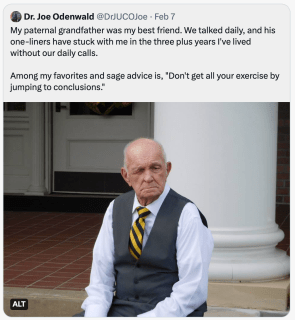
I am always appreciative of the good stuff we see on social media. It is also good to follow like-minded friends. So, the other day I ran across this great post from my friend Joe Odenwald who posted the below picture with thoughts…

Screen Shot 2023-02-08 at 11.22.11 AM

So, the masterful quote by Joe’s grandfather, “Don’t get all your exercise by jumping to conclusions.” When I saw and read that, I responded to Joe that I would put it on my quote list of quotes to remember. I love hearing and learning new stuff; that quote is one of the best lately.

So, about those people who jump to conclusions… they seem to be everywhere. I’ll admit, I’ve done it a time or two myself. Not so much the older I get, but I can remember the times I have; it didn’t work out all so well. Can you remember times you have? But the question remains, why do we?

The effect of doing so is normally unwanted. I see jumping to conclusions as ignorant of the facts and not knowing the situation or the person (we see this constantly with social media and the hiding behind a keyboard).

There are actually psychological studies done on this subject. I guess there is enough material; go figure. In a blog post (and a good read) by Leandra McIntosh and Nick Hobson, People Who Jump to Conclusions Show Reasoning Errors, False Beliefs, Overconfidence and Impaired Learning a study was done by the Journal of Personality and Social PsychologyIn that study, the researchers found that people who displayed high JTC (Jumping to Conclusions) behavior made significantly more errors, were more likely to endorse conspiracy theories, and demonstrated more knowledge corruption. I’m like, I know a lot of folks that fit these characteristics.

Let’s segue into the leadership world and tie this into education. Leaders/teachers should edge on the side of being sensitive of not jumping to conclusions. The ones who do, turn it into an art that is not a pretty picture. It takes us only a short time to see how really ineffective they are on a daily basis.

The more information out there, the more opportunity we have not to know everything. However, when it comes to making conclusions, more information is better. Without time, effort, a little digging, and, most of all, thinking, all we can do is make assumptions. When we do this, we create a persona that leads people to say, “It sure is scary how they think.”

Even worse, when leaders jump to conclusions, they will seek out others for affirmation who share a similar point of view, or they will find others who are afraid of the ramifications if disagreement is not allowed.

Really good leaders are aware that they are not perfect. We all have blind spots and biases. That’s why it is so important to be open, have independent facts, not always your own, and seek others for helpful information, even if they disagree. But many of you know this, and I’ve said before, if a person has their mind made up, it doesn’t matter what the truth is.

So, I have never thought about an exercise that could actually weaken your muscles. Still, if jumping to conclusions is the only exercise you do, I believe it weakens your mind to the fullest extent and, by default, weakens your creditability.

I’m glad my friend posted something good earlier this week that strengthened my thought process. I’m also glad that he mentioned receiving sage advice. I’m glad I have people who can provide me with the same. I hope you do as well. Now, time to exercise…

Let’s go fight the good fight of leadership. Someone has to…

Go be a great educator and leader today… Our future needs it…

Remember… Think Leadership and Be For Others…

©2023 J Clay Norton

Want more Leadership Thoughts? Follow me on… Twitter @thebookchamber or follow the blog directly.