Tags
business, Education, Educational Leadership, Leader, Leadership, Learning, Respect, school, Teachers, teaching
As educational leaders, we are constantly looking for what works. We study assessment results, compare data, develop improvement plans, introduce new programs, and monitor whether those efforts are producing the outcomes we expected. This is an important part of leadership because schools and universities should always be looking for ways to serve students more effectively.
However, in the devotional I’m reading this year Things Unseen: One Year of Reflections on the Christian Life , by Sinclair Ferguson (highly recommend if you are looking for a devotional), recently caused me to think more carefully about the question, “What works?” In this particular devotion, Ferguson warned that success can become a temptation when it is measured primarily by visible results, public recognition, or the approval of others. Although the passage was written about ministry, the principle applies just as clearly to educational leadership. If we are not careful, we can become so focused on finding what works that we fail to consider whether the methods we are using are right.

Something may produce the result we want and still not be good for the people involved. A new initiative may improve a particular number while placing an unreasonable burden on teachers. A policy may create immediate compliance while gradually weakening trust. A leader may appear decisive and effective, even though employees no longer feel comfortable expressing concerns or offering a different perspective. From the outside, the organization may look successful, but the people within it may feel exhausted, overlooked, or undervalued.
This does not mean that results are unimportant. Educational leaders are responsible for student learning, instructional quality, responsible use of resources, and the overall effectiveness of their institutions. We should establish goals and expect progress. At the same time, the results we achieve cannot be separated from the way we achieve them.
For those of us who approach educational leadership from a Christian worldview, effectiveness must be accompanied by faithfulness. We must consider whether our decisions are consistent with our values, whether they honor the dignity of others, and whether they genuinely advance the mission we have been called to serve. Before adopting a strategy simply because it appears likely to work, we should consider whether it is honest, fair, sustainable, and beneficial to students and those who serve them. We also need to consider whether it strengthens the organization or achieves a temporary result at the expense of the people responsible for carrying it forward.
A worthy goal does not justify an unworthy method.
The devotion also raised another issue that is common in educational leadership: the temptation to compare ourselves with others. Schools, districts, universities, programs, and leaders are regularly compared through test scores, rankings, enrollment numbers, awards, completion rates, and public recognition. Social media has intensified this pressure by allowing us to see a carefully selected picture of what others appear to be accomplishing.
Comparison can be useful when it helps us identify effective practices and learn from the success of others. It becomes unhealthy when someone else’s success begins to feel like a threat to our own. At that point, we may become more interested in finding fault with another leader’s work than in examining what we might learn from it. We may even begin to believe that diminishing another person’s accomplishments somehow strengthens our own position.
There are certainly times when educational leaders must challenge poor decisions, identify ineffective practices, or address actions that are harmful to students and employees. Honest evaluation and accountability are essential to healthy organizations. However, there is a difference between addressing a legitimate concern and criticizing someone simply to make ourselves appear more knowledgeable, capable, or successful. Constructive criticism should help move people and institutions toward improvement. If our criticism only tears down and offers no responsible path forward, we need to examine both our approach and our motives.
This leads to a question that may be more important than simply asking whether our leadership works: What are we building through the way we lead?
Educational leadership should build the knowledge and confidence of teachers, strengthen relationships with families and communities, create greater opportunities for students, and establish a culture in which people can acknowledge mistakes and continue to grow. It should also build trust between leaders and those they serve. If our leadership produces impressive results but leaves people discouraged, fearful, or unwilling to speak honestly, then we have not fully succeeded.
Leadership should never be primarily about protecting a reputation, creating a personal platform, or accumulating recognition. The authority associated with leadership is a stewardship, and it has been entrusted to us for the benefit of others. This understanding is especially important for Christian leaders because Scripture consistently connects leadership with service, humility, responsibility, and faithfulness. Our calling is not simply to achieve visible success. It is to use our influence wisely and for the good of the people and institutions placed in our care.
Successful educational leadership should include measurable improvement, but our definition of success must be broad enough to include how that improvement was achieved. We should pursue excellence, study effective practices, make difficult decisions when necessary, and hold ourselves and others accountable. We should also make certain that our pursuit of improvement does not become separated from character, mission, and genuine care for people.
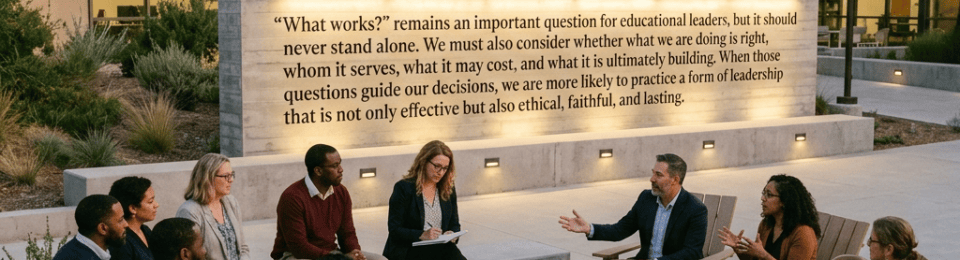
“What works?” remains an important question for educational leaders, but it should never stand alone. We must also consider whether what we are doing is right, whom it serves, what it may cost, and what it is ultimately building. When those questions guide our decisions, we are more likely to practice a form of leadership that is not only effective but also ethical, faithful, and lasting.
As you step into your role today, remember that you are not just an educator and leader but a shaper of the future. Your actions and decisions profoundly impact the lives of those you guide. Go, be the great educator and leader that our future needs.
Remember… Think Leadership and Be For Others…
©2026 J Clay Norton
Want more Leadership Thoughts? Follow me on… X @thebookchamber or on FaceBook at J Clay Norton or follow the blog directly.

