Gratitude in Leadership – A Perspective on Leading with Thankfulness in Education

Tags

, , , , , , , , ,

In educational leadership, the power of gratitude can be profound, often transformative. We can see how this works repeatedly when teachers pour themselves into students and even when administrators pour themselves into teachers. We can all give testimony that there are times when “things” do not go our way, and it hurts, often even infuriating us. However, from a Christian leadership perspective, gratitude is more than just a mindset; it is rooted in humility and grace. When leaders acknowledge blessings in their work, they are able to approach each day with renewed purpose, compassion, and resilience. Remember, it’s a mindset!

For those in leadership, particularly in education, it’s easy to focus on challenges: limited resources, the weight of decision-making, large classroom sizes, salary inadequacies, discipline issues, managing competing needs, and juggling time for family. I am sure you can add to the list… However, a heart of gratitude can reframe these challenges as opportunities for growth. Anchoring in thankfulness can inspire by showing that gratitude isn’t dependent on circumstances, as detrimental as they might seem, it’s a reflection of a deep-seated trust in God’s provision. And what a provision we have that we, as educational leaders, are entrusted to teach the future of society.

gratitudeappreciation1-300x199

Thankful leaders also create a ripple effect throughout the school environment by keeping the culture thriving and promising. When leaders intentionally express appreciation for teachers, staff, and students, they reinforce the value of each person’s contributions. This simple act of actual, personable recognition empowers, fosters teamwork, and strengthens relationships. But please understand that recognition needs to be more than an automatically generated email telling how much you value and appreciate their efforts (we can get ChatGPT to do that…). People naturally want edification, and such encouragement goes a long way in a school setting when done with a personal touch. A culture of gratitude doesn’t just boost spirits; it creates a shared sense of purpose. When we give people a reason to belong, they will want to belong.

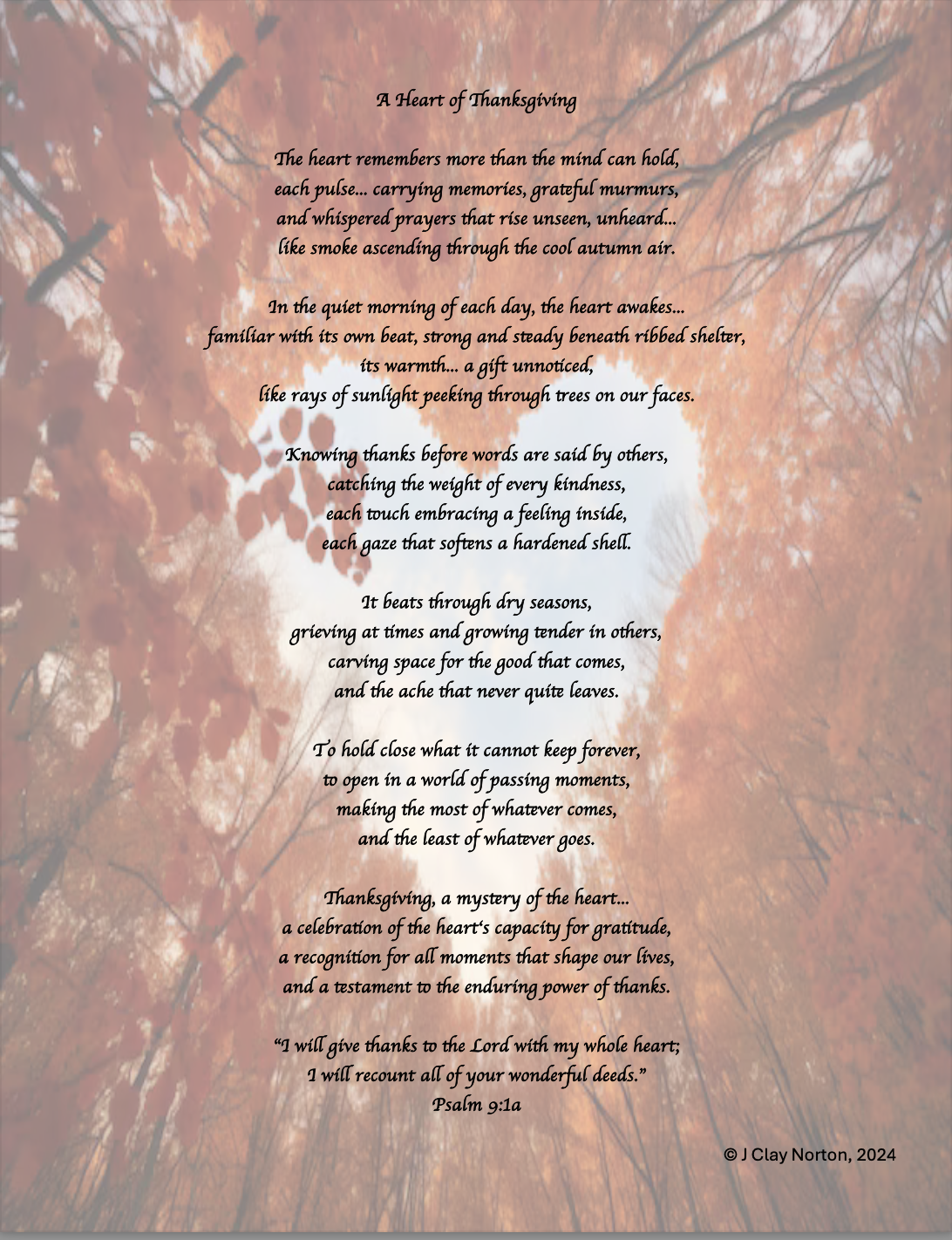
At its core, leading with thankfulness embodies the humility and love at the heart of Christianity. During this Thanksgiving season, it’s easy to either feel grateful or overlook gratitude; it all comes down to perspective. Thanksgiving offers an opportunity to inspire gratitude in others and to foster an environment where faith and respect guide our actions.

When educational leaders and all people, for that matter, root themselves in gratitude, they create a positive, supportive atmosphere where both teachers and students can thrive. In this way, gratitude becomes more than just a virtue; it becomes a powerful force for transformation.

As you step into your role today, remember that you are not just an educator and leader but a shaper of the future. Your actions and decisions profoundly impact the lives of those you guide. Go, be the great educator and leader that our future needs.

Remember… Think Leadership and Be For Others…

©2024 J Clay Norton

Want more Leadership Thoughts? Follow me on… X @thebookchamber or follow the blog directly.

Want to share this leadership thought with others? Click on one of the social media sharing buttons below and help spread the good…


Theological Thoughts about Leaders and Leadership…

Tags

, , , , , , , , , , , , , , , ,

This blog post is something that I have been thinking about for some time… even before the recent election. I have many conversations with myself… go figure. One question I often ask myself is, “How did so and so a person get that job?” or “Why was that person selected for that role?” As Christians, one of our greatest witnessing tools is ourselves; we are on public display 24/7. Regardless of those in authority and leadership positions in general, I am comforted that I serve a God in total control…

In the aftermath of any election or a new leadership change, emotions can run high. We see it on TV, hear it on the radio, podcasts, etc. I’ve been on both sides of this with many elections thus far since my time voting. A winning majority often feels relief, and the other half is disappointed, and vice versa; prayers are answered and unanswered, it seems. However, as a Christian, there’s a theological truth I find confidence in that offers profound peace in times of political change and any change of leadership at any level, for that matter… God is sovereign, controlling the entire universe, and knows what is best. Romans 8:28 states, “And we know that for those who love God all things work together for good, for those who are called according to his purpose.” All things are all things and do not adhere to any categories. This concept of sovereignty means that God rules over all creation, history, and human affairs, including elections and those in leadership. Regardless of the outcome, as Christians, we can trust that nothing happens outside His knowledge and purpose.

explore-the-bible-mystery

In Scripture, we see that God’s will unfolds in two ways: His revealed will and His secret will. Deuteronomy 29:29 states, “The secret things belong to the Lord our God, but the things that are revealed belong to us and to our children forever, that we may do all the words of this law.” God’s revealed will consists of the principles and commands He has given us through Scripture… directives for living lives of integrity, justice, and love. His secret will, however, includes those things He has chosen not to disclose fully to us, such as specific plans for nations or why particular leaders rise and fall. Though we may not understand why God allows certain leaders to come into power, we can trust that His secret will is at work for His glory and, ultimately, for the good of those who love Him. What Scripture is silent on, it is silent. This foundational belief reassures us that no leader or election result surprises Him. His purposes are ultimately beyond our understanding, yet they always serve a greater good and work according to His divine plan. This is indeed a mystery.

The Bible teaches us in Daniel 2:21a that “He changes times and seasons; he removes kings and sets up kings.” This verse reminds us that the authority of every leader is granted by God Himself. Whether we support a person in leadership or not, we can trust that God has a purpose for the leadership in place and that His wisdom far exceeds our own. One clear command in God’s revealed will is that we are to pray for our leaders. Paul writes in 1 Timothy 2:1-2, “First of all, then, I urge that supplications, prayers, intercessions, and thanksgivings be made for all people, for kings and all who are in high positions, that we may lead a peaceful and quiet life, godly and dignified in every way.” Oh, how hard this often seems and actually is. Whether or not we agree with those in office or even in any leadership position, praying for wisdom, justice, and guidance for our leaders aligns our hearts with God’s purposes and keeps us rooted in humility.

As we move forward and live daily, I find comfort in God’s sovereignty, praying for our leaders in authority and trusting that God’s plans, though sometimes hidden, knowing that they are always good and perfect. At the same time, as leaders, we have a responsibility to foster unity and peace, and lead with wisdom, justice, and compassion.

As you step into your role today, remember that you are not just an educator and leader but a shaper of the future. Your actions and decisions profoundly impact the lives of those you guide. Go, be the great educator and leader that our future needs.

Remember… Think Leadership and Be For Others…

©2024 J Clay Norton

Want more Leadership Thoughts? Follow me on… X @thebookchamber or follow the blog directly.

Want to share this leadership thought with others? Click on one of the social media sharing buttons below and help spread the good…
Seeking a Thrill in Leadership? It’s Scary…

Tags

, , , , , , , , , , ,

With yesterday being October 31st and Halloween. Many people dressed and wanted to create a scare and possibly a thrill. A purposeful thought, nonetheless, reasoned for whatever. But here’s a thought: do we ever wonder if those who seek a thrill actually scare people?

DALL·E 2024-11-01 07.12.03 - A thought-provoking image illustrating the theme of thrill-seeking versus responsible leadership. Show a leader standing on a dimly lit stage, wearing

I believe it happens more than we realize in leadership every day…

At its core, leadership is about responsibility and should not be thrill-seeking. When individuals chase, want, and advocate for leadership roles for the excitement or the ego boost, it often leads to dangerous outcomes. Most of the time, that danger is hidden. Leadership is not inherently glamorous; it comes with pressures, accountability, and the weight of guiding others toward shared goals; this in itself should humbly scare. However, when leaders pursue the role for excitement or a desire to be in control, it can lead to impulsive behaviors that make decision-making and risk-taking harmful to any established positive culture. This is a danger we must be cautious of.

True leaders (and it’s unfortunate that we have to put “true” in front of leader(s)) find satisfaction not in the thrill of power but in fostering growth mindsets, collaboration, and positive change. Leadership requires vision, patience, and sometimes empathy; all of which can be diminished when someone is drawn to leadership simply for the excitement it provides. Thrill-seeking leaders may overlook key processes, undervalue teamwork, and make decisions that prioritize short-term excitement over long-term success, especially if it benefits them first.

Leadership is ultimately about being a servant and then empowering others. Leaders are entrusted with the well-being, development, and performance of those they guide. When leadership becomes a pursuit for personal excitement, it creates a disconnect between the mission and vision and from the needs of those who provide for the stability of the culture. Leaders who approach their roles with a sense of duty and responsibility rather than thrill-seeking inspire trust, loyalty, and respect.

Leadership is also a stewardship given by God. An opportunity to influence others in a way that reflects His character. A servant-based approach turns the pursuit of leadership upside down, challenging a thrill-seeker to let go of personal ambition and instead focus on uplifting others. The excitement in leadership should come from seeing positive transformation and growth in those we serve, not from the prestige of the position.

Should we be scared by those seeking a thrill in leadership? I say yes. Thrill seekers who obtain leadership positions are more than likely wearing a mask anyway. Seems fitting since yesterday was Halloween…

As you step into your role today, remember that you are not just an educator and leader but a shaper of the future. Your actions and decisions profoundly impact the lives of those you guide. Go, be the great educator and leader that our future needs.

Remember… Think Leadership and Be For Others…

©2024 J Clay Norton

Want more Leadership Thoughts? Follow me on… X @thebookchamber or follow the blog directly.

Want to share this leadership thought with others? Click on one of the social media sharing buttons below and help spread the good…

Leading with Intensity or Intentionality… Which One?

Tags

, , , , , , , , , , , ,

We see it almost every game in the world of sports… One word, intensity. On the other hand, we see the opposite, a stoicism of intentionality. As a former basketball coach, I get it… the need to motivate, fuss, correct, celebrate, etc. However, I became a better coach when I tapered off those moments of intensity. One of my coaching mentors, Stan Jones, told me once, “If you fuss and holler all the time, when you actually need to, the players will not know the difference.” I would give that same advice to young coaches now. I would also give it to all those at any leadership level.

be6cb344-6297-491a-a900-2c65a253d6ef

In leadership, the allure of leading with intensity is often strong. We live in a fast-paced world where results are expected quickly, and leaders usually feel pressured to drive people hard, pushing toward ambitious goals and maintaining relentless focus on outcomes. However, while it can achieve short-term gains, leading with intensity often leads to burnout, poor decision-making, and a gradual erosion of a positive culture over time. Every leader should be aware of these negative characteristics.

Leading with intentionality offers a more sustainable and effective approach. Think of it as a natural resource. When leaders are intentional, they focus on achieving goals and how those goals are pursued. Intentional leaders lead with clarity of purpose, ensuring that every decision aligns with the broader mission and values that determine who they are and who the organization is. Rather than pushing with an intensity of negativity and possible belittlement, intentional leaders take a step back to ensure engagement, support, and empowering others to become the standard. Intentional leadership prioritizes the why behind our actions rather than just the how or what, inspiring a sense of purpose and motivation. This fosters a culture of trust and collaboration, seeking results and holistic growth, encouraging personal development, and an opportunity for people to flourish.

While intensity might fuel a leader in moments of crisis or during short bursts of effort, I do not believe it should be a defining style. Leaders who consistently lead with intensity often need to catch up on the nuances that lead to lasting success. Intentionality, however, brings balance, purpose, and foresight, ensuring that both the leader and their team can sustain high performance over time. It would almost allow others to believe you are clairvoyant… 🙂 

From a Christian Worldview perspective, leading intentionally means listening, adapting, and seeking God’s wisdom in decision-making. This doesn’t necessarily mean waiting for divine intervention but rather using the principles and values found in the Bible to guide your leadership. Leadership rooted in intentionality reflects the servant-leader model of Christ, one that brings glory to God and leaves a lasting impact on the hearts of those we serve.

In the end, it’s not about how loudly or forcefully you lead; it’s about how wisely you guide others toward a shared vision. I have seen and been around many leaders of both styles and there is a drastic difference.  

Go be a great educator and leader today… Our future needs it…

Remember… Think Leadership and Be For Others…

©2024 J Clay Norton

Want more Leadership Thoughts? Follow me on… X @thebookchamber or follow the blog directly.

Want to share this leadership thought with others? Click on one of the social media sharing buttons below and help spread the good…